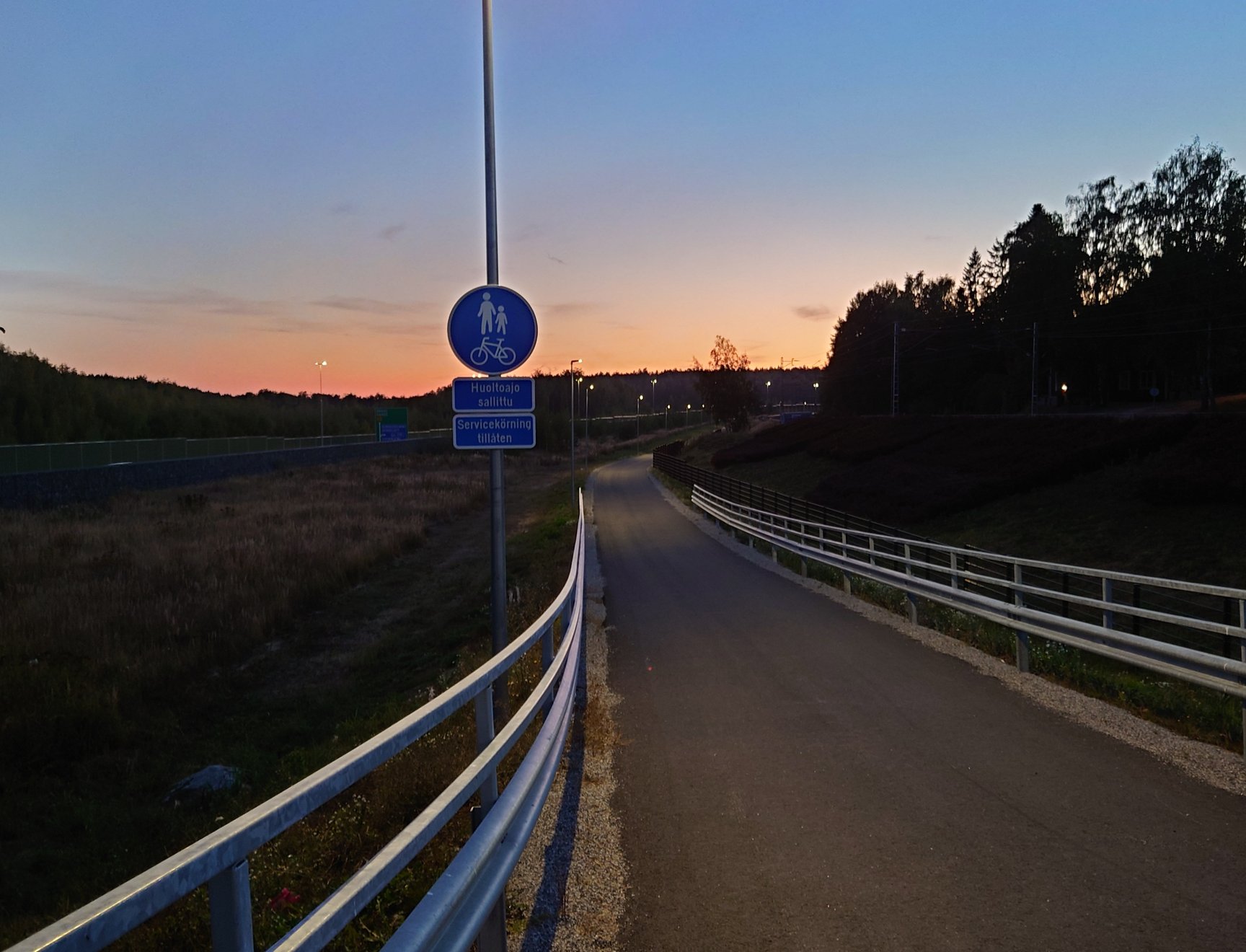
Kirkkonummi’s transport infrastructure has been built on the terms of private car use — and it is pedestrians, cyclists and families with children who pay the price. That is, for light traffic — for example pedestrians and cyclists. Today, car use seems to be an ever more central part of our lives, and it is already used to justify the marketability of apartments. The car is often offered as a solution to many problems, even though it is frequently part of what caused the problem in the first place. What if we approached solutions from a slightly different angle?
Is the car essential for commuting?
The first and most common reason for travelling anywhere is going to work. Over 60% of the municipality’s working residents commute to the Helsinki metropolitan area, and of these, nearly half to Espoo. Getting to work is of course essential, but the car does not need to be the primary mode of transport for everyone. To Espoo, for example, one could cycle even year-round, provided the infrastructure is adequate. This has already been done successfully in Oulu, and it would not be impossible in Kirkkonummi either. Another option is public transport, which suffers from a kind of vicious cycle: when bus or train timetables do not suit you well, you are more likely to use your own car — and when more people use their own cars, public transport becomes less viable and is cut back.
What if local services were genuinely nearby?
For families with children, another need for travel is children’s hobbies. Especially when children first need to be brought home after school and then taken to hobbies and back later in the evening. But if hobbies were organised around the school day — for example right after school in the same area — the need for trips would decrease significantly.
In particular, children of kindergarten age need to be driven to and from kindergarten and cannot be sent on their own.
Which brings us to the next travel need for families: school and kindergarten transport. Even if it were financially beneficial for the municipality to close smaller schools and kindergartens and consolidate institutions, that does not make daily life easier for families with children. In particular, children of kindergarten age need to be driven to and from kindergarten and cannot be sent on their own. The shorter the distances, the higher the threshold for going by car, which also avoids the problems of drop-off traffic.
City centres and the cost of inactivity
The centre of Kirkkonummi has also changed significantly over the years and continues to change. More parking has been added, but at the same time more shops have closed than opened. Meanwhile, around the world, there is a growing shift towards car-free city centres, and Finnish research also shows that cyclists and pedestrians bring more money to local shops than those arriving by car. What if we applied more of the same thinking to our own town centre? What would Kirkkonummi’s centre look like then?
The estimated cost of physical inactivity to the state is €3.2–7.5 billion per year.
According to the most recent personal mobility survey, the car is already the primary mode of transport for trips of under 3 kilometres. The same applies to trips of under 10 minutes. At the same time, according to a Ministry of Transport and Communications study, the estimated cost of physical inactivity to the state is €3.2–7.5 billion per year. The significance of cycling and walking for health is enormous, and while car use does bring great freedom of movement, it can also be dangerous for light traffic, as anyone who has walked or cycled in Porkkalanniemi can attest from personal experience.
While waiting for a golden mean, let us all try to be a little less rushed and make room for the journey itself.
Updated 25 June 2026. The situation has not changed materially — Kirkkonummi’s transport infrastructure remains built around private car use. The argument in this post is still current.
I have written more about public transport and infrastructure: about the public transport cost crisis, about my vote for the Western Metro extension and about winter maintenance problems. Read more in my posts on transport.
Also published in: Kirkkonummen Sanomat, 11 September 2022.
Other posts
-
Public transport cannot keep getting more expensive
HSL plans significant fare increases for buses and trains. This risks a downward spiral — fewer users means more pressure to raise prices further.
-
New year, familiar poor winter maintenance in Kirkkonummi
Kirkkonummi's winter maintenance has again proved as poor as in previous years. It does not have to be this way — we can choose to demand quality.
-
The West Railway revealed problems in Kirkkonummi's governance
The West Railway decision revealed shortcomings in Kirkkonummi's strategic planning. The municipality risks bearing the costs without the benefits.
-
I voted for the Western Rail Link
I voted for Kirkkonummi to join the Western Rail Link. The decision determines whether Northern Kirkkonummi gets a commuter rail station.